Oak patina
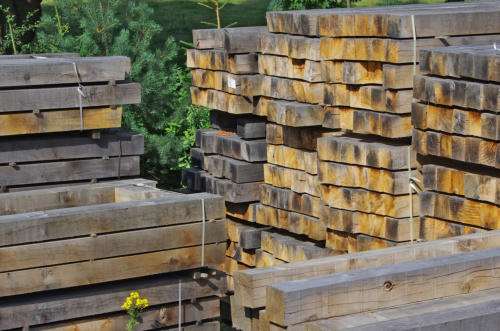
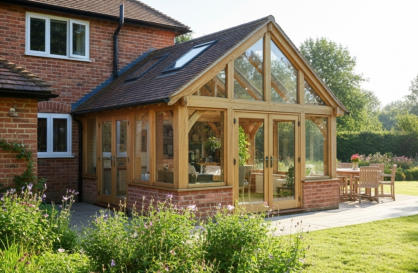
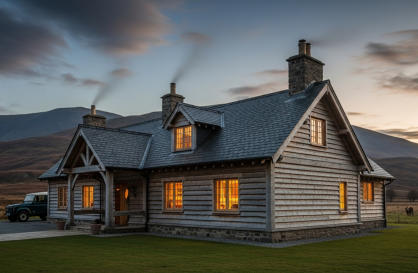
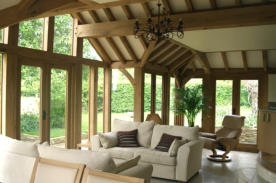
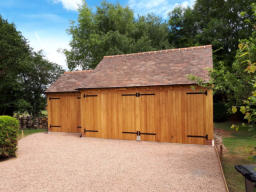
Oak patina refers to the natural surface character that develops on oak wood as it ages. It’s highly valued in furniture, architecture and antiques because it signals authenticity, age and use rather than wear-and-tear damage. Most photographs in brochures or on websites show oak buildings as a creamy gold colour, this is because most photographs are taken within twelve months of the building being constructed. Externally, oak frames will change in colour to a grey colour (unless stained) but internally the oak will retain the creamy warm gold colour for many years.
What creates patina on oak
Oak patina forms through a combination of:
•
Oxidation – exposure to air slowly darkens the wood
•
Light (UV exposure) – especially sunlight, which deepens colour over
decades
•
Tannins – oak is rich in tannic acid, which reacts with air, moisture,
and metals
•
Handling and use – oils from hands, abrasion and polishing soften
edges and add warmth
•
Time – true patina can’t be rushed completely; it accumulates over
years or centuries
How oak patina looks
Depending on age and environment, patinated oak may show:
•
Warm honey, amber, or deep brown tones
•
Subtle variation in colour (not flat or uniform)
•
Slight darkening around joints, carvings, or touch points
•
A soft sheen rather than a glossy finish
•
Visible grain with depth and contrast
In historic buildings and furniture, oak patina often has a “smoky” or mellow glow that modern finishes struggle to replicate.
Historical context
Because oak was widely used in:
•
Medieval and Tudor buildings
•
Churches and monasteries
•
English and European furniture (16th–18th centuries)
…oak patina is strongly associated with heritage interiors. Conservators take great care
not to remove it, as stripping oak destroys historical value and evidence of age.
Can oak patina be recreated?
Partially - but it’s never identical to real age.
Common methods include:
•
Fuming with ammonia (reacts with oak tannins to darken it)
•
Iron solutions (vinegar + steel wool) to create grey-brown tones
•
Oil finishes (linseed, tung) to warm and deepen colour
•
Gentle wear and repeated waxing over time
These can mimic colour, but not the layered complexity of genuine patina.
Why people value oak patina
•
Signals authenticity and craftsmanship
•
Adds visual depth and warmth
•
Increases antique and architectural value
•
Connects objects to history and long-term use

© 2016
Oak patina
Oak patina refers to the natural surface character that develops on oak wood as it ages. It’s highly valued in furniture, architecture and antiques because it signals authenticity, age and use rather than wear- and-tear damage. Most photographs in brochures or on websites show oak buildings as a creamy gold colour, this is because most photographs are taken within twelve months of the building being constructed. Externally, oak frames will change in colour to a grey colour (unless stained) but internally the oak will retain the creamy warm gold colour for many years.
1.
Initial Concept & Feasibility
We can help with as little or as much as you require. Whether it’s supply only of an oak frame or a full build turnkey project, please contact us with your requirements. The majority of our buildings are either supply only or supply and install although we work closely with First Image builders in the South East and LME Building in the Midlands. • Define Your Vision: Start with a clear idea of what you want to achieve. What is the purpose of the building? What style do you envision (traditional, contemporary, barn-style)? What's your budget? • Initial Consultations: Contact us for a free initial consultation and 3D design visuals. We can advise on the feasibility of your ideas and potential costs. If you are looking for an extension, whether it be a Garden Room, Orangery or Conservatory, we would usually do a site visit to measure up although we can produce a design idea from photos and a few client dimensions. If you place an order based on a remote sketch for a building, we would need to do a check survey. For garages, stables or other stand- alone buildings we can design something based on your requirements. • Site Assessment: We will consider the site's characteristics – size, access, ground conditions, existing structures and orientation for natural light. • Sketch Designs: We produce 3D sketch designs for your project showing you how the changes will look on your property. This is a free service and once you are happy with the design, we can quote for the oak frame.2. Design & Planning
Detailed Design:
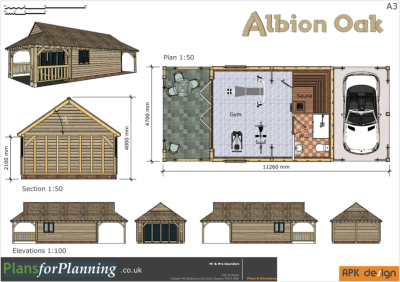
If you have worked with an oak frame company or architect to develop designs, we can quote from their drawings although we may suggest alternatives if we think the design can be improved upon. This includes not just the oak frame itself but how it integrates with other building elements like glazing, cladding, roofing and internal layouts. We are also happy to produce 3D rendered views of the building to give you a realistic look of the building. • Green Oak Considerations: We provide Oak frame specialists design with the understanding that 'green oak' (recently felled and unseasoned) will shrink and develop characterful cracks (shakes) as it dries. Joints are precisely cut to tighten as the timber shrinks, increasing the frame's strength. • Air Dried Oak: Seasoned Oak has been dried for a number of years to reduce the moisture content. This is usually used in glazed buildings so that the oak shrinkage is minimal.Structural Engineering:
• A structural engineer will be involved to provide calculations and ensure the design meets all structural requirements, especially for attaching the oak frame to existing structures (for extensions) or for complex new builds.Planning Permission:
• Like any building project, an oak frame building will likely require planning permission unless it falls under Permitted Development (PD) rights. • PD rights for extensions and outbuildings have specific criteria regarding size, height, proximity to boundaries and location (e.g., Conservation Areas, AONB’s, Listed Buildings often have stricter rules). • Even if your project falls under PD, it's advisable to apply for a Lawful Development Certificate for formal proof. We can assist with preparing drawings and documentation for planning applications or we can take on the full planning process via Plans For Planning.Building Regulations:
• All oak frame buildings (except for very small, non-habitable garden sheds below a certain size) must comply with Building Regulations. • This covers foundations, structural integrity (though oak's inherent strength often simplifies this aspect for the frame itself), fire safety (oak chars slowly, providing very good fire resistance), energy efficiency (Part L, usually achieved by wrapping the frame in highly insulated panels like Structural Insulated Panels - SIPs - or using infill systems), ventilation, sound insulation and accessibility. • We will provide detailed plans that building control officers or approved inspectors will use for approval and inspections during construction.3. Fabrication
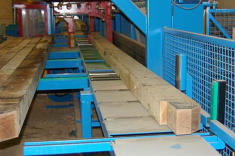
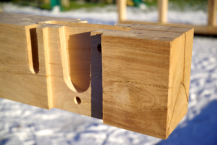
• Timber Sourcing: We source our oak from sustainably managed forests, usually France, or sometimes, the UK. • Crafting the Frame: This is where the magic happens. The oak timbers are traditionally cut and jointed in the company's workshop using a combination of modern machinery (e.g., CNC for precision) and traditional hand tools. Joints are precisely cut using mortise and tenon, scarfs, and other techniques, secured by oak pegs. • Pre-assembly: Sections of the frame are test-assembled in the workshop to ensure perfect fit before transportation to the site. This off-site fabrication significantly speeds up on-site construction. • Pre-delivery: The frame sections are checked, labelled and then banded together ready for delivery. Joinery is wrapped to give further protection from the elements and stored inside to ensure it arrives on site in perfect condition.4. Site Preparation & Erection
• Groundworks & Foundations: This is typically managed by a local groundworks contractor. The foundations (e.g., concrete strip foundations, raft foundations, or pile foundations depending on ground conditions) must be perfectly level and accurate to receive the oak frame. • Delivery: The pre-cut oak frame components are delivered to the site. • Assembly (Raising the Frame): This is often the most visually impressive part of the process. Our oak frame carpenters, often with the aid of a crane for larger sections, assemble and raise the frame on the prepared foundations. This process is surprisingly quick, often taking just a few days for a substantial frame. • Sole Plates: Accurate laying of timber sole plates on the foundations is critical as the entire frame rests on these.5. Enclosure & Finishing
Once the oak frame is erected, the building needs to be enclosed and finished:Enclosure System:
• SIPs (Structural Insulated Panels): This is a very common method for enclosing oak frames. SIPs are pre-fabricated panels consisting of an insulating foam core sandwiched between two structural facings (e.g., OSB). They are highly insulating, lightweight and create a very airtight building envelope around the oak frame, which is exposed internally. • Infill Panels/Traditional Methods: Other methods include using infill panels of timber studwork, brick, or masonry, which are then insulated. • Roofing: Installation of roof structure (often incorporating oak trusses) and roofing materials (slate, tile, thatch, etc.). • Glazing: Installation of windows, doors, and large glazed sections (e.g., bi- fold doors, glass gables) that are specifically designed to fit within the oak frame's natural movement. • External Cladding: Applying external finishes like timber cladding (e.g., cedar, larch), brick, stone, or render. • First Fix: Installation of internal services (plumbing, electrics), internal partition walls, and insulation within the walls and ceilings (if not using SIPs). • Plasterboarding: Applying plasterboard to internal walls and ceilings (often directly to the timber frame elements or SIPs). • Second Fix: Installation of internal joinery (doors, skirting, architraves, stairs), sanitaryware, electrical fittings, and final decoration. • External Works: Landscaping, driveways, etc.Benefits of Oak Frame Buildings:
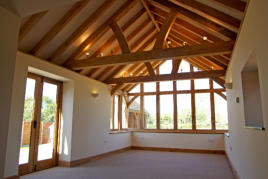
• Aesthetics & Character: The exposed oak timbers create a unique, warm, and inviting interior with a timeless aesthetic and a sense of craftsmanship. Vaulted ceilings and open-plan spaces are easily achieved. • Longevity & Durability: Oak is incredibly strong and durable. As green oak dries, its strength increases and the joints tighten. Many oak frame buildings have lasted for centuries. • Sustainability: Oak is a renewable resource, and using it locks away carbon for the building's lifespan. Responsible suppliers source from sustainably managed forests. Minimal processing is required compared to other materials. • Thermal Performance: When combined with modern enclosure systems like SIPs, oak frame buildings can achieve excellent thermal efficiency, often exceeding standard Building Regulations and leading to lower energy bills. • Predictable Construction: Much of the frame is fabricated off-site, reducing on-site build time, labour costs and potential weather delays. • Increased Property Value: Oak frame extensions and homes often add significant value and appeal to a property due to their unique character and quality.Considerations/Disadvantages:
• Cost: Oak frame construction typically has a higher initial cost than standard brick and block or softwood timber frame, with the oak frame itself accounting for a third to half of the total build cost. However the speed on site can make the costs quite comparable. • Shrinkage & Movement: Green oak will naturally shrink, twist and develop shakes (cracks) as it dries. While designed for, this is a characteristic that some people may not prefer or understand. It requires specialist detailing for windows, doors and internal finishes. • Specialist Skills: Requires specialist oak frame designers, carpenters and often a main contractor experienced in this type of construction particularly on larger projects. • Insurance: While fire-resistant (large oak sections char slowly and the central core remains. A steel frame will melt and collapse in a fire long before an oak frame), some insurers might initially categorise it as "non- standard construction," requiring specialist quotes. However over recent years this is becoming much less of an issue. The process of getting an oak frame building is a collaborative effort between the client, specialist oak frame company, architect, structural engineer and contractors, resulting in a beautiful, durable and distinctive structure.
 About
About
 Products
 Quotations
 Technical
 News
News
 Blog
Blog
 Inspiring Oak Frame Extension Ideas for Your Home
- Which Extension Style Should You choose?
 Jungle of Regulation Is Choking Small-Scale Development
 Is an Oak Frame Conservatory the Perfect Extension for Your Home?
 Oak Frame Flat Roof Extensions
 What should I consider when designing an oak frame extension?
 Contact
 Frequently Asked Questions
 Self Build
 Oak Frame Design
 Grades of Oak
 Longevity of Oak
 Services
 The Process
 Design Requirements
 Site Preparation
 Sustainability
 Construction Methods
 Feasibility Study
 Gallery
 Garages
 Single Storey Garages
 Two Storey Garages
 Garage Complexes
 Extensions
 Garden Rooms
 More Info
 Conservatories
 More Info
 Traditional Orangeries
 Mansard Orangeries
 Garden Buildings
 Annexes
 Entertainment Spaces
 Home Offices
 Shelters
 Pool Buildings
 Stables
 House Designs
 Commercial
 Barn Buildings
 Sport Buildings
 Bespoke Buildings
 Single Storey Garage
 Two Storey Garage
 Garden Rooms, Orangeries & Offices
 Design
 Architectural Design
 Case Studies
 Oak Framing History
 Glossary of Oak Framing
 Oak Patina
 Garage Frame Sections
 Cladding
 Planning
 Planning Reports
 Building Regulations
 Non-Designated Heritage Assets
 Caravan Sites
 Groundworks
 Assembly
 Supply Only Kits
 Turnkey Projects
 Joinery
 Glazing Options
 Lanterns
 Roof Works
 Roof Styles
 Roof Trusses
 Roof Tiling
 Albion Oak
 Employee of the Month
menu html5 by Css3Menu.com


© 2016 - Need help? Contact us on 07967 778808
